About Us
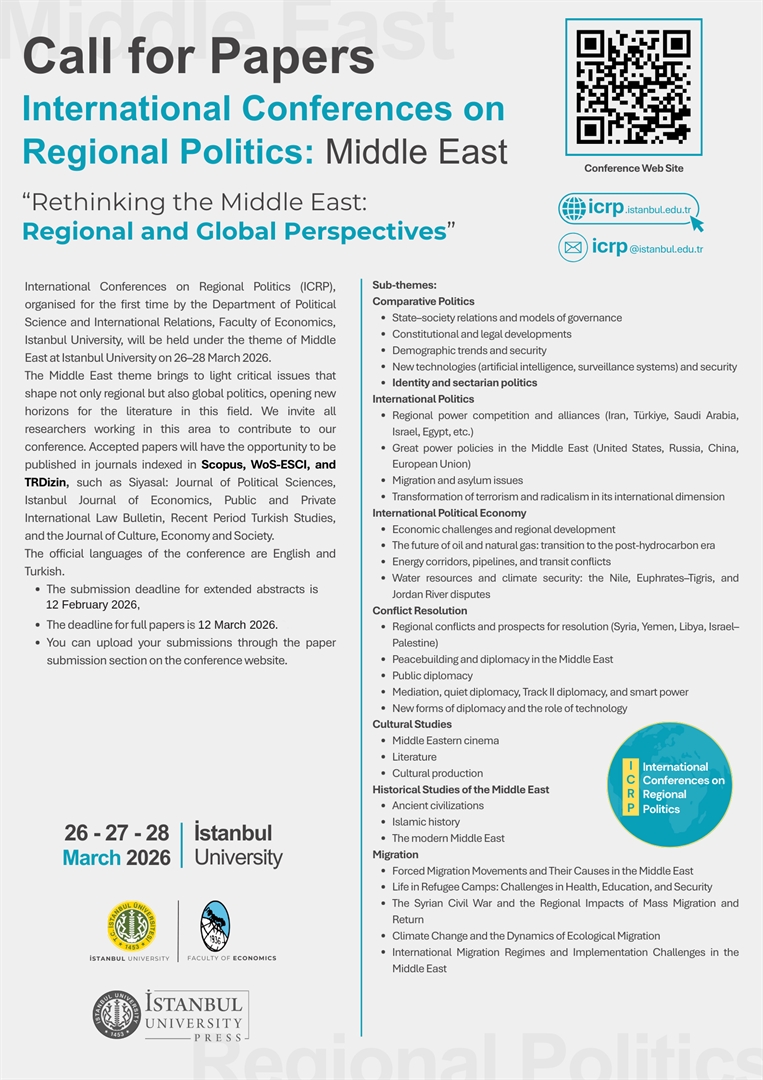
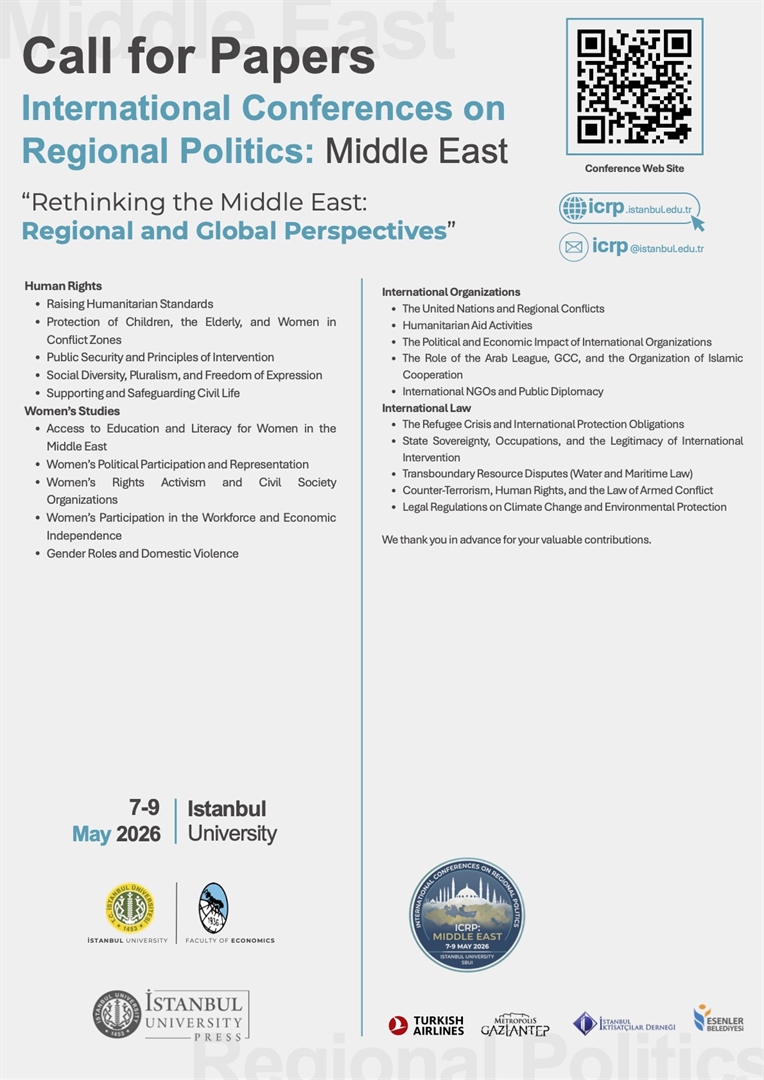
International Conferences on Regional Politics (ICRP): Middle East
“Rethinking the Middle East: Regional and Global Perspectives”
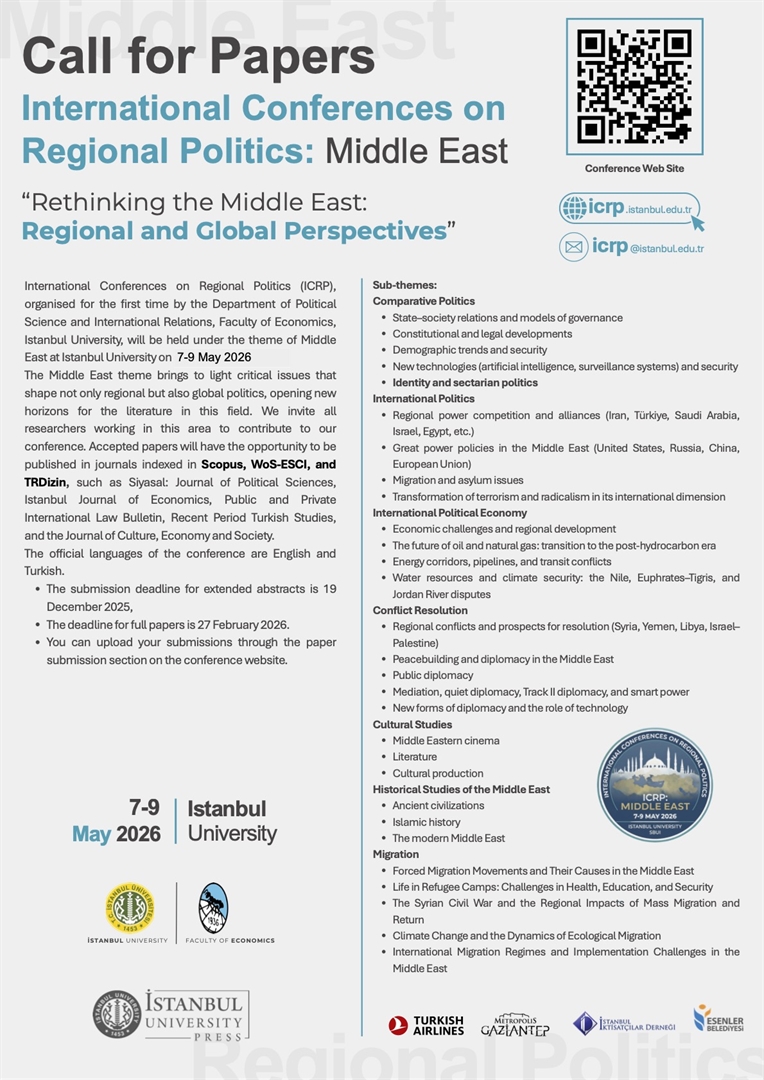
International Conferences on Regional Politics (ICRP), organised for the first time by the Department of Political Science and International Relations, Faculty of Economics, Istanbul University, will be held under the theme of Middle East at Istanbul University on 7-9 May 2026.
The Middle East theme brings to light critical issues that shape not only regional but also global politics, opening new horizons for the literature in this field. We invite all researchers working in this area to contribute to our conference. Accepted papers will have the opportunity to be published in journals indexed in Scopus, WoS-ESCI, and TRDizin, such as Siyasal: Journal of Political Sciences, Istanbul Journal of Economics, Public and Private International Law Bulletin, Recent Period Turkish Studies, and the Journal of Culture, Economy and Society.
The official languages of the conference are English, Turkish and Arabic.
The submission deadline for extended abstracts is 12 February 2026.
The deadline for full papers is 12 April 2026.
You can upload your submissions through the paper submission section on the conference website.
Sub-themes:
Comparative Politics
State–society relations and models of governance
Constitutional and legal developments
Demographic trends and security
New technologies (artificial intelligence, surveillance systems) and security
Identity and sectarian politics
International Politics
Regional power competition and alliances (Iran, Türkiye, Saudi Arabia, Israel, Egypt, etc.)
Great power policies in the Middle East (United States, Russia, China, European Union)
Migration and asylum issues
Transformation of terrorism and radicalism in its international dimension
International Political Economy
Economic challenges and regional development
The future of oil and natural gas: transition to the post-hydrocarbon era
Energy corridors, pipelines, and transit conflicts
Water resources and climate security: the Nile, Euphrates–Tigris, and Jordan River disputes
Conflict Resolution
Regional conflicts and prospects for resolution (Syria, Yemen, Libya, Israel–Palestine)
Peacebuilding and diplomacy in the Middle East
Public diplomacy
Mediation, quiet diplomacy, Track II diplomacy, and smart power
New forms of diplomacy and the role of technology
Cultural Studies
Middle Eastern cinema
Literature
Cultural production
Historical Studies of the Middle East
Ancient civilizations
Islamic history
The modern Middle East
Migration
Forced Migration Movements and Their Causes in the Middle East
Life in Refugee Camps: Challenges in Health, Education, and Security
The Syrian Civil War and the Regional Impacts of Mass Migration and Return
Climate Change and the Dynamics of Ecological Migration
International Migration Regimes and Implementation Challenges in the Middle East
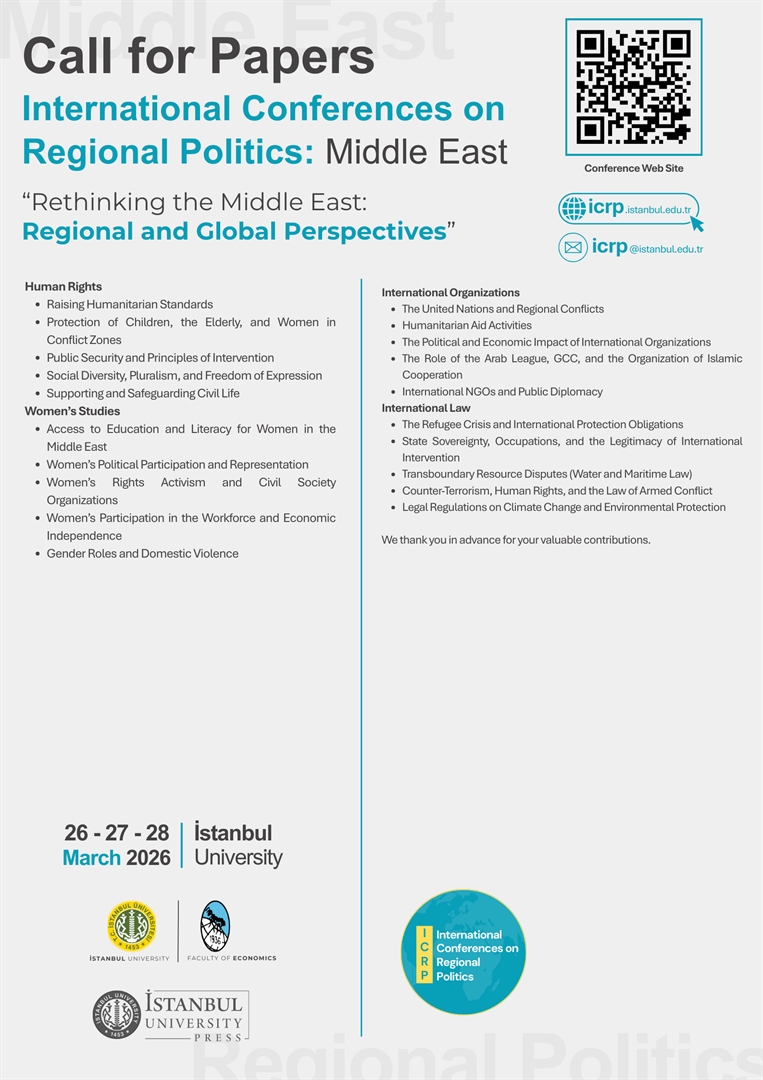
Human Rights
Raising Humanitarian Standards
Protection of Children, the Elderly, and Women in Conflict Zones
Public Security and Principles of Intervention
Social Diversity, Pluralism, and Freedom of Expression
Supporting and Safeguarding Civil Life
Women’s Studies
Access to Education and Literacy for Women in the Middle East
Women’s Political Participation and Representation
Women’s Rights Activism and Civil Society Organizations
Women’s Participation in the Workforce and Economic Independence
Gender Roles and Domestic Violence
International Organizations
The United Nations and Regional Conflicts
Humanitarian Aid Activities
The Political and Economic Impact of International Organizations
The Role of the Arab League, GCC, and the Organization of Islamic Cooperation
International NGOs and Public Diplomacy
International Law
The Refugee Crisis and International Protection Obligations
State Sovereignty, Occupations, and the Legitimacy of International Intervention
Transboundary Resource Disputes (Water and Maritime Law)
Counter-Terrorism, Human Rights, and the Law of Armed Conflict
Legal Regulations on Climate Change and Environmental Protection
We thank you in advance for your valuable contributions.
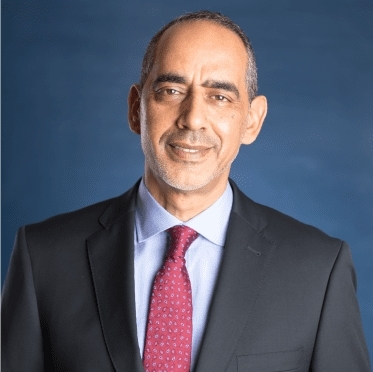 |
Tarik Yousef |
Middle East Council on Global Affairs |
Tarik M. Yousef is a senior fellow at the Middle East Council on Global Affairs. Prior, he served as the director of the Middle East Council on Global Affairs and Brookings Doha Center and was a nonresident senior fellow in the Foreign Policy program at the Brookings Institution in Washington, DC. He is a research fellow with the Economic Research Forum in Cairo. His career has spanned the academic and think tank world at the School of Foreign Service of Georgetown University, the Belfer Center for Science and International Affairs at the Harvard Kennedy School, and the Global Economy and Development program at Brookings. His involvement with public policy includes working in the Middle East Department at the International Monetary Fund, the Middle East and North Africa region at the World Bank, and the UN Millennium Project. He has contributed more than 75 articles, chapters, and reports, and co-edited several volumes including most recently “The Belt and Road Initiative: China-Middle East Cooperation in an Age of Geopolitical Turbulence” (Brookings Doha Center and the Shanghai Academy for Social Sciences, 2019); “Public Sector Reform in the Middle East and North Africa: Lessons of Experience for a Region in Transition” (Brookings Press, 2020); and “The Gulf Cooperation Council at Forty: Risk & Opportunity in a Changing World” (Brookings Press, 2021). Yousef has served on the boards of the Middle East Economics Association; United Nations Development Programme Human Development Reports; Arab Human Development Report; Arab Knowledge Report; Gender Economic Research and Policy Analysis in the Arab World; The Social and Economic Survey Research Institute; the Global Agenda Councils of the World Economic Forum; and the Arab Banking Corporation. |
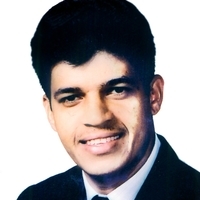 |
Prof. Dr. Saeed Mubarak Al-Muharrami |
Sultan Qaboos University |
Saeed Mubarak Al-Muharrami is a Full Professor in the Department of Economics and Finance at the College of Economics and Political Science, Sultan Qaboos University, and a distinguished expert in Finance, Banking, and Monetary Economics. Since January 2025, he has served as a Member of the Board of Directors of Central Bank of Oman. Previously, he was a Member of Majlis Al-Dawla (State Council), the upper house of Oman’s Parliament from November 1995 to October 2023. He also served as Dean of the College of Economics and Political Science at Sultan Qaboos University from March 2014 to July 2017, having earlier held the position of Director of the Humanities Research Center. In academia, he was appointed as a Fulbright Program Visiting Scholar at the International Monetary Fund (IMF) during the 2011/2012 academic year. He earned his B.Sc. in Finance from University of Arizona, USA, his MBA from Oregon State University, USA, and his PhD in Finance and Banking from Cardiff University, UK. Professor Al-Muharrami is the author of eight books, seven book chapters, and numerous scholarly articles. His publications have been widely recognized and highly cited by economists, academics, bankers, and researchers worldwide. Three of his works are used as teaching and reference materials in eleven universities. Throughout his career, Professor Al-Muharrami has received numerous awards in recognition of his excellence in research, teaching, and distinguished leadership. |